Planning a family outing is a simple task for most people: Grab your keys, step out the door, and go. But for caregivers like Keli Osborne, every trip requires intense preparation, strategic routing, and endless contingency plans for her son, Logan.
Keli’s 9-year-old son was born with L1CAM syndrome, a rare genetic condition that affects his mobility and physical development. Logan uses a manual wheelchair, is nonverbal, and requires full support for transferring to be changed and personal care.
Like most 9-year-olds, Logan plays T-ball and loves to go camping, but navigating public spaces without consistent access to accessible changing options means his family often has to find workarounds that don’t provide the privacy, safety, and dignity he deserves.
For facility managers and architects, Logan’s story highlights a critical gap in modern public design: Standard ADA compliance often leaves those with complex physical needs out entirely.
The Anatomy of an Outing: Packing and Planning
Every outing requires extensive planning. So, research is the first step
Will there be appropriate, private spaces available for Logan?
Do venues offer specialized gear, such as beach wheelchairs and mats?
Is there wheelchair-accessible seating and entry rules for events?
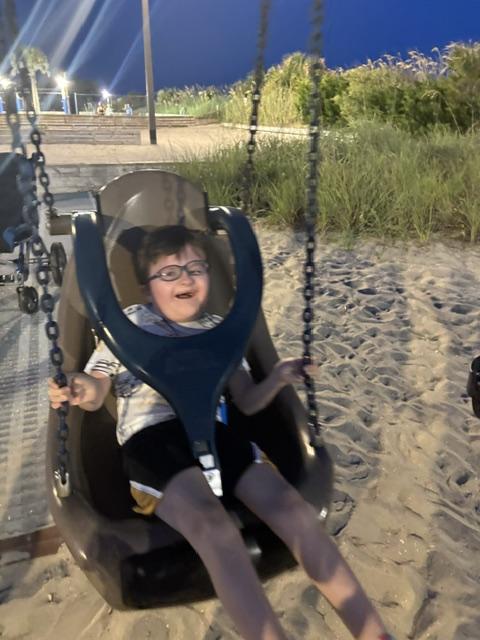
Do local parks feature wheelchair-accessible swings?
Are the overall layout and amenities comfortable and manageable for Logan’s needs?
Then before actually leaving the house, she must anticipate and pack everything she may require in the face of any potential medical or personal needs.
“A typical outing means I have to pack a whole bag,” Keli said. “I have to carry his emergency rescue medications — he has a severe peanut allergy and epilepsy — plus water, snacks, diapers, wipes, and a tablet to keep him engaged. We also need a vehicle big enough to hold his wheelchair, his adaptive stroller, and all of our gear.”
Emergency Backups: The Reality of the Trunk
Handling Logan’s restroom needs in public is its own challenge. With his condition, ADA-accessible stalls lack the space, lifting equipment, and privacy needed. Also, he is too large for standard baby changing tables.
That leaves these options for public restroom use:
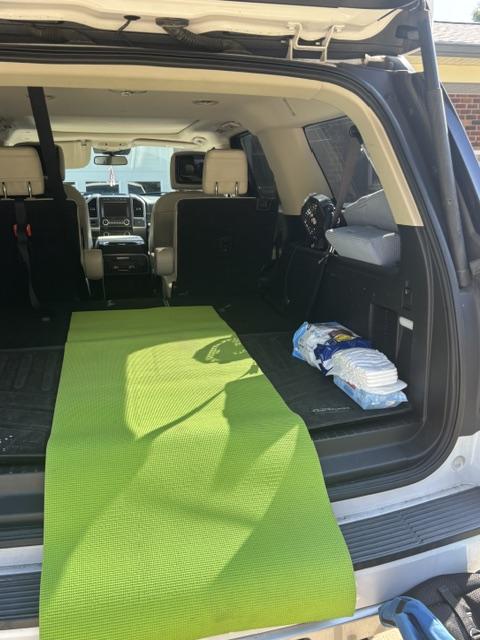
The back-of-the-car method: Keli keeps a yoga mat in the back of her Ford Expedition MAX to lay Logan down for changes. While functional, it lacks privacy, exposes him to weather elements, and forces him to be changed in public view.
Bathroom benches: During a college graduation event with no reentry allowed, Keli had to change Logan on a small bench inside a crowded, high-traffic restroom. Leaning over at an awkward height while trying to shield him from passersby created an uncomfortable experience for both of them.
First aid/medical rooms: At a Major League Baseball game, stadium staff directed Keli to the first aid room. While private, air-conditioned, and clean, it was 20 stadium sections away from their seats. And the table was not height-adjustable, making the transfer more difficult.
“He can’t speak, but he expresses his feelings,” Keli said. “You can tell by the look on his face when he’s miserable or embarrassed. It takes away their dignity when they don’t have a safe, quiet, and private place to change.”
Limiting Life: The Events That Get Left Behind
When the stress of finding appropriate facilities outweighs the joy of the activity, the family simply chooses to stay home.
Whether it’s skipping local college football games or opting out of community trips to mountainous areas such as Gatlinburg, the absence of proper facilities forces families to miss out on shared experiences.
The Game-Changer: Height-Adjustable Adult Changing Stations
For building owners and operators, event directors, and designers, adding an adult changing table ensures you are creating spaces where every family belongs. But choosing the right table is also critical. While standard flat tables or medical cots offer a surface, they miss a critical component of safety and ease: height adjustability.
A height-adjustable station with a changing surface that can be lowered down to standard wheelchair heights (around 12 inches off the ground) and raised up to a comfortable working height for each individual personal care attendant (up to 41 inches).
Key Advantages of Height-Adjustable Tables
Safe transfers: Allows caregivers to transfer an individual by pivoting or sliding them onto the changing bed, which eliminates dangerous heavy lifting.
Caregiver ergonomics: Prevents back strain and injuries caused by bending over low surfaces or kneeling on hard floors.
Knowing a public facility has provided dedicated restrooms with a universal changing station completely changes a caregiver’s mental state. Instead of feeling anxious about time limits, fluid intake, privacy, or emergency cleanups, caregivers can focus entirely on enjoying the day.
A Message to Architects, City Planners, and Building Owners
If building operators, architects, and city planners assume that standard ADA-compliant restrooms are sufficient, they are only serving those individuals who can self-transfer to a toilet. Children and adults such as Logan who require full-transfer changing care get left out completely.
Keli’s message to designers and decision-makers is straightforward: “If you make facilities truly accessible for everybody from the start, you don’t have to build separate, makeshift workarounds later. Don’t design for able-bodied people first and then treat accessibility as an afterthought out back by the dumpster. Just make it universal.”
By installing height-adjustable adult changing stations in public spaces, venues, parks, and stadiums, you open the door for every family to enjoy public life with safety, comfort, and dignity. Ready to make your facilities inclusive for every family? Explore Koala Kare’s height-adjustable adult changing stations to learn more.
Baby changing stations are a long-term fixture; once installed, they often remain in your washroom until the next major remodel or relocation. Choosing a unit based solely on a lower upfront price can create significant hidden costs for your business.
A cheap changing station does more than risk premature wear; it actively shapes how customers perceive your facility. Low-cost units can drag down the aesthetic of an otherwise modern restroom, lack the recognizable brand name that gives parents peace of mind, and often fall short when it comes to long-term hygiene, durability, and safety standards.
During the course of several years, thousands of families will walk through your doors and use that station. Is a cheap, unreliable fixture the impression you want to leave with them? Investing in a higher-quality solution ensures your restrooms reflect the high standards of your business.
That’s why providing a Koala Kare baby changing station is more than just a washroom fixture. It’s a long-term investment in your business.
The Most Visible Fixture in Your Restroom
Baby changing stations are among the largest wall-mounted features in a commercial washroom. Because of their size, they are seen by every visitor who walks through the door and either elevates your restroom’s visual tone or completely disrupts it.
Koala Kare offers a portfolio of baby changing stations with units that integrate seamlessly into any modern aesthetic. Featuring sleek, contoured shapes, new contemporary plastic finishes, and stainless steel, our stations offer the versatility needed to match your facility’s design rather than clash with it.
KB300 Series: Combine durability with contemporary style in modern neutral tones or stainless steel veneers.
KB310/311 Series: Delivers a high-end architectural finish using seamless surfaces, smooth contours, and zero visible weld lines.
Vertical options: Optimizes limited wall space while maintaining clean lines and fully compliant with ADA.
Even if you regularly refresh your facility, it’s easy to overlook an aging changing table. Over time, older or off-brand units warp, sag, stain, and discolor, becoming a visual eyesore that signals poor maintenance. Replacing an outdated unit with a modern Koala Kare station immediately restores the professional look of your washroom, reassuring visitors with a brand logo synonymous with quality, safety, and hygiene.
Koala Kare Is Built Around a Heavy-Duty Steel Frame
Baby changing stations support your customers’ children; they have to be safe and strong. This is why Koala changing stations are built around a solid steel frame for superior strength. The primary benefits of this internal steel frame include:
Structural strength: The enhanced internal steel frame has been tested to withstand significant weight, exhibiting minimal deflection when subjected to 200 lbs. of center-loaded static weight.
Long-term durability: As the unit’s backbone, the steel frame prevents the plastic from warping, bowing, or wearing out over time, even in demanding, high-traffic environments.
Enhanced safety and compliance: By housing the steel frame inside the plastic body of the station, Koala Kare ensures there is a rugged, unbreakable connection to the wall. These units are engineered in accordance with ASTM safety standards and designed to assist facilities in maintaining ADA compliance when properly installed (including our vertical configurations).
Hygiene that Lasts: Microban® Product Protection for Life
Koala Kare is the only baby changing station manufacturer to infuse Microban product protection directly into the changing bed during construction, so it lasts the entire life of the product, no matter how many times you clean it.
What Is Microban and How Does It Work?
Microban is an antimicrobial technology integrated directly into the polymer structure during manufacturing.
The antimicrobial surface helps to reduce odors and keeps the bed surface cleaner between cleanings because it works at the cellular level to disrupt the growth of odor- and stain-causing bacteria, mold, and mildew.
Looks Good for Years, Not Just on Day One
Nearly every customer who enters your establishment will visit the washroom, meaning your changing station is on display to almost everyone, whether they use it or not. By providing a Koala Kare baby changing station, you invest in a solution that:
Complements or even enhances your washroom design and finishes
Resists fading, staining, and daily wear and tear
Maintains an attractive, clean appearance for years to come
Ready to Upgrade Your Commercial Washroom?
Don’t let a low-cost changing station cost you returning customers. Explore the full portfolio to find a baby changing station that will help your restrooms stand out while giving you peace of mind.
The condition and appearance of your washroom have a significant impact on how people perceive your business or facility.
Cleanliness is about more than appearance. If soiled diapers are left in standard trash bins, lingering odors can undermine an otherwise well-maintained washroom and leave users with a negative impression.
But thankfully, it’s an easy problem to solve. Providing diaper disposal bags is a simple, low-cost way to improve the washroom experience. For facilities with compatible Koala Kare baby changing stations, keeping them stocked with KB160 Diaper Pouch™ bags encourages the proper disposal of used diapers.
Here are five types of facilities where providing diaper disposal bags can help keep washrooms cleaner, reduce odors, and increase user satisfaction.
What Are Diaper Disposal Bags and Why Provide Them?
Diaper disposal bags give parents a simple, sanitary way to dispose of soiled diapers before discarding them into trash receptacles. Because most of these receptacles usually don’t have a lid or cover, using these bags helps keep washrooms smelling better between cleaning cycles, especially in high-traffic facilities where bins aren’t emptied after every use.
The result is a better experience for everyone. Parents appreciate amenities that make diaper changes easier, while other washroom visitors benefit from a cleaner, more pleasant environment.
Compatible Koala Kare baby changing stations include a dedicated compartment for The Diaper Pouch bags, making them easy to keep stocked and readily available when families need them.
1. Food Service: Protect Customer Appetite
Unpleasant washroom experiences can instantly kill an appetite and possibly lead to a negative online review, regardless of food quality. Providing diaper disposal bags gives parents a simple way to contain odors and helps keep the washroom looking and smelling better.
2. Transportation: Handle Nonstop Use
Travelers often spend hours in airports, train stations, and other transit hubs, where restrooms see constant use.
Diaper disposal bags help reduce odors between cleaning cycles, especially in facilities where trash bins can’t be emptied after every use.
3. Entertainment Venues: Manage the Rush
Stadiums, theaters, and theme parks experience high volumes of visitors during halftimes, intermissions, and parades. The heavy influx of users can make it challenging for custodial staff to keep up with increased restroom traffic and full trash receptacles.
Diaper disposal bags prevent the entire washroom from smelling like a landfill before the maintenance crew can break through the crowds to empty the bins.
4. Healthcare: Keep It Clean
Hygiene perception is critical in clinics, hospitals, doctors’ offices, and urgent care facilities. Providing diaper disposal bags makes it easier for users to maintain clinical cleanliness in your facility.
5. Retail and Shopping Malls: Extend Shoppers’ Stay
Baby changing stations are an amenity at the mall that keep parents coming back. By keeping supplying disposal bags to help neutralize odors, you encourage shoppers to extend their stay in your store or at the mall.
To show parents that the facility considers their needs, provide The Diaper Pouch cartridge in the dedicated spot in your Koala Kare baby changing station and keep them stocked.
Frequently Asked Questions
How should diapers be disposed of in public washrooms?
Place the used diaper inside the bag, tie off the bag, and place it in the designated trash receptacle. Never flush diapers or wipes.
Can you flush diaper disposal bags or baby wipes down the toilet?
No. Diapers, baby wipes, and diaper disposal bags should never be flushed. They do not break down in water and will cause severe plumbing clogs or municipal pipe damage.
Are diaper disposal bags easy to use?
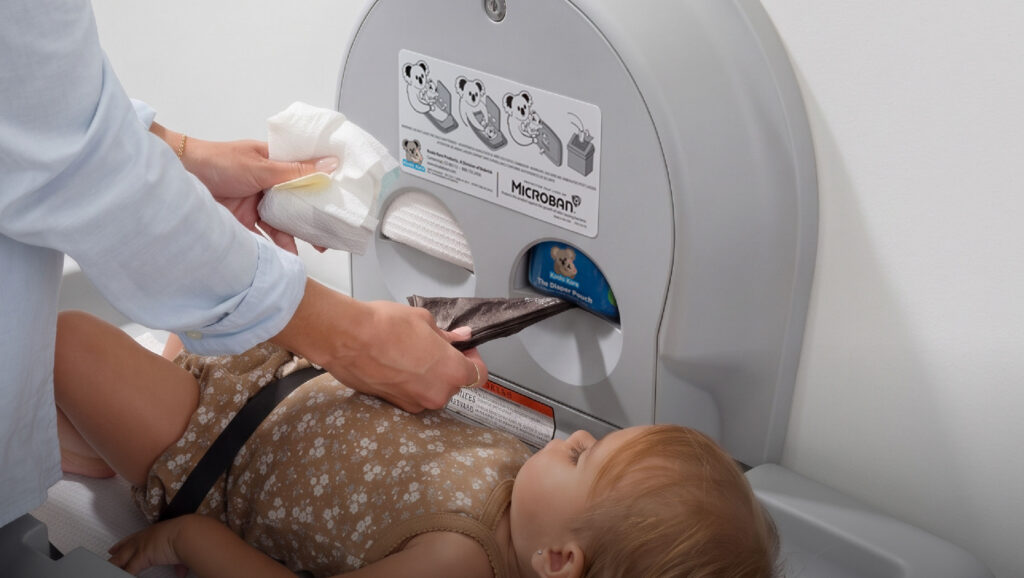
Yes. The Diaper Pouch dispenses one bag at a time from one of the two dispensers found inside any KB200, KB300, KB301, KB310, or KB311 baby changing stations from Koala Kare. Users can pull out a bag and open it easily without having to move away from the baby on the changing station.
Is it easy to keep The Diaper Pouch installed and stocked?
Yes! Each cartridge contains 175 easy-to-open diaper disposal sacks. Easy to place, it fits into the liner cavities in any of Koala Kare’s KB200, KB300, KB301, KB310, and KB311 baby changing stations.
Pair Disposal Bags with Koala Kare Changing Stations
Need an upgrade? A complete family restroom experience includes the right baby changing station. If your existing baby changing station doesn’t include a dedicated disposable diaper bag dispenser, it may be time for an upgrade. See all of Koala Kare’s baby changing stations to find one that fits your space.
Already have a compatible station? Baby changing stations with a dedicated spot for The Diaper Pouch are designed to allow facility maintenance teams to quickly check if they are empty and are incredibly easy to restock. Koala Kare baby changing stations with built-in dispensers make it easy to keep diaper disposal bags available for guests when they need them.
Walk into any beautifully designed restaurant, and the adult seating is thoughtfully curated. Adding high chairs into the mix should not mean that the aesthetic has to take a hit.
Finding a high chair that complements your restaurant’s design is important, but so is choosing one that delivers a positive experience for families. Seven out of 10 parents are more likely to visit a business that provides high-quality child seating.
Modern, easy to clean high chairs made with durable materials are an investment in your business. They satisfy family customers, reduce liability, make life easier for your staff, and blend with the design and style of the rest of the building.
But a high-end steakhouse has different needs than a bustling fast-casual restaurant or coffeehouse. From the classic Diner and contemporary Designer to the premium, flat-folding Stowe, here is how to select the model that best fits into your overall design.
The Benefits of Koala Kare High Chairs
High chairs need to satisfy parents’ expectations, keep busy staff moving, and survive daily wear and tear. Koala Kare premium high chairs are engineered to solve these front-of-house challenges.
Every model delivers these core benefits designed to elevate your operations and protect your brand:
Modern style: Styled with a contemporary design element that blends seamlessly with upscale adult furniture.
ASTM safety compliance: Certified to fully comply with the latest ASTM safety standards.
Space-saving storage: Designed to stack or fold flat easily, keeping walkways clear and open.
Built-in misuse prevention: Engineered so they cannot be flipped upside down to hold infant carriers, eliminating a significant potential liability.
Rapid cleanability: Built with nonporous plastic surfaces that are impervious to crumbs and liquids, allowing staff to wipe them down completely in seconds.
Commercial durability: Built from rugged, heavy-duty components that stand up to high-traffic settings.
By checking every box for safety, hygiene, and style, Koala Kare Products makes it simple to upgrade your guest experience. Here is how each specific model stacks up.
Stowe High Chair: The Standard for Style
The high-end design and silhouette of the Stowe integrates seamlessly with the vibe of contemporary establishments. With its sleek, minimalist lines, this model elevates boutique, upscale, and modern restaurant interiors. Key advantages include:
A premium combination of warm, natural beechwood paired with high-grade plastic at the contact points.
A flat-fold innovation that ensures compact storage and space savings.
A lightweight frame for staff and customers to carry.
Designer High Chair: The Ultimate Blend of Style and Safety
Thanks to its durable construction and functional design, this high chair offers several distinct advantages, including:
A sleek design and color choices that match many modern restaurant designs and decor.
A textured surface that resists scuffing, chipping, and scratching.
A seamless, solid composition of high-density polyethylene (HDPE) plastic, which is more durable and sanitary in comparison to standard wood high chairs.
Diner High Chair: The Updated Restaurant Staple
The Diner is the ideal solution for high-traffic establishments seeking a durable, hygienic upgrade from traditional wood high chairs. Its benefits include:
A nonporous, smooth plastic surface that allows for quick and thorough cleaning.
An easy-to-carry, easy-to-maintain structure that is stackable when not in use.
A highly affordable classic that stands up to daily commercial wear and tear.
Matching the Right Chair to Your Concept
See how the models compare in this table to help you select the best model for you.
High Chair
The Stowe
The Designer
The Diner
Vibe
Sleek, contemporary, and high-end
Clean and modern
Functional and traditional
Footprint
Foldable to store flat
Stackable
Stackable
Composition
Beechwood and plastic
Solid HDPE plastic
HDPE plastic
Colors
Black
Grey, Black, Red, Brown
Grey, Black, Brown
Product dimensions (assembled)
18″ W x 27 1/2″ H x 21″ D
18″ W x 30″ H x 23″ D
22 1/4″ W x 30 1/4″ H x 23 1/2″ D
Carrying weight
14 lbs.
18 lbs.
10 lbs.
Best for
Upscale, boutique, and space-conscious
Contemporary dining rooms, outdoor patios, malls, and food courts
Q: How many high chairs should my business provide?
A. While your needs will vary depending on your concept size, hours of operations, and other factors, a good rule of thumb is to provide one high chair for every 20-30 dining seats.
Q: Is it safe to flip a high chair upside down to hold an infant car seat?
A. Flipping a high chair upside down to balance an infant car seat may be a widespread practice, but it is not recommended. Doing so is dangerous as upside-down high chairs can be easily tipped. Koala Kare’s high chairs cannot be flipped, which eliminates this safety hazard. Instead, consider offering the KB115 Infant Seat Kradle to give families a safe spot to hold their infant carriers at table height.
Looking to Upgrade your Child Seating? We Can Help
Providing safe, high-quality seating shouldn’t mean compromising your restaurant’s aesthetic and efficiency. Whether you need the space-saving innovation of the Stowe, the modern durability of the Designer, or the high-traffic reliability of the Diner, Koala Kare Products has you covered.
In high-end commercial architecture, the washroom is a critical piece that contributes to a reflection of the entire building for everyone, not just parents.
Whether or not a guest plans to use the baby changing station, a unit with a dated design or finish makes the entire washroom look and feel like an afterthought. When the right station is specified in concert with the overall space, it becomes a seamless extension of the building’s architectural intent.
To deliver a five-star experience, designers must look beyond the unit itself and consider the entire washroom. This is also especially true for parents and caregivers who want a hygienic changing station that makes them feel confident they can safely tend to their baby’s needs. Here are five hidden features that elevate a baby changing station from a functional utility to a high-end architectural statement.
1. Cohesive Visual Integration
The design tension: Baby changing stations occupy a large physical footprint, and traditional standard units often introduce visual disruption. Clunky industrial gray or off-white plastic fixtures clash in a washroom with walls and floors made of custom stone, elegant dark wood, or matte black hardware, turning a necessary amenity into a major distraction.
The modern solution: To shift the focus from a basic utility to aesthetic harmony, intentionally select a finish that is specified to mirror the room’s color, textures, and overarching architectural style so it blends seamlessly into high-end wall materials.
The Koala Kare edge: Koala Kare Products offers design options to ensure the unit complements premium washroom palettes. The KB310 and KB311 series feature matte black and classic stainless steel finishes that align with high-end fixtures. For completely bespoke spaces, talk to your Koala Kare Products representative about custom powder coat colors that can perfectly match any specific partition or accessory colors and finishes.
2. The User Experience
The design tension: Guests carrying luxury diaper totes or personal bags aren’t thrilled to place items on the floor or have them hang off the station, which is difficult to reach and undermines their experience.
The modern solution: A changing station should never be specified in isolation. Consider adding a dedicated point-of-use bag hook installed at a height that allows the bag to rest at the same level as the changing surface, typically 34–38 inches from the floor.
The Koala Kare edge: The 310-54 Stainless Bag Hook, which comes standard with our KB310 and KB311 changing stations, mounts on the wall next to the station and matches in finish. Engineered to support heavy luxury totes (20+ lbs.), it ensures that high-value items stay clean, dry, and easily accessible.
3. Engineering the Sound of Silence
The design tension: The jarring drop and slam of a some lower cost changing tables can break the spa-like immersion of a premium setting
The modern solution: Luxury is defined by the absence of mechanical noise. High-end specifications should provide acoustic dampening and soft-return hardware to ensure the station operates with silent precision.
The Koala Kare edge: Using a concealed pneumatic cylinder and a reinforced integral steel frame, Koala Kare Products offers baby changing stations that provide a controlled, feather-touch opening. This minimizes mechanical vibration and noise, enhancing the composed atmosphere of the environment. Plus, a smooth and quiet opening tells the parent or caregiver the baby changing station is safe and sturdy for their baby.
4. The Invisible Defense Layer
The design tension: In a post-pandemic landscape, hygiene is no longer an amenity; it is a requirement. Guests view public surfaces with skepticism, and they want to know that what they put their child on is sanitary.
The modern solution: Specify products with built-in protection. By integrating antimicrobial technology directly into the product’s base material, the station provides a passive, 24/7 defense layer.
The Koala Kare edge: Microban® product protection, a brand that many parents recognize and will appreciate seeing, is integrated during the manufacturing process of the KB310 and KB311 changing stations, ensuring it will not wear off over time. When paired with our dispensers for sanitary bed liners and diaper disposal bags, the station remains in an “always-ready” state without additional wall-mounted clutter.
5. The Architecture of Cleanliness
The design tension: Just because a restroom is clean, doesn’t mean that users will think it is clean. It must also look clean (i.e.: modern). An outdated or cumbersome fixture subtly signals a lack of modern cleanliness and rigorous facility maintenance.
The modern solution: To reassure every guest, architects must design for all users by specifying changing stations with sleek, unbroken lines and flat surfaces that visually communicate pristine, modern hygiene standards.
The Koala Kare edge: The KB310 and KB311 series function as true design assets rather than functional obligations. Engineered with one-piece, deep-drawn steel construction and modern finish options, their design eliminates seams, weld lines, and sharp edges for a uniform, modern aesthetic that elevates the surrounding space.
Ready to integrate high-end functionality into your next project?
True luxury is found in the the details and removal of visual clutter. When a baby changing station is treated as an intrinsic, high-performance component of the modern restroom, it ceases to be a mere utility. Instead, it becomes a powerful gesture of hospitality that speaks volumes about the quality of the entire facility.
Our team is ready to help you integrate high-end functionality into your architectural vision. Contact your local Koala Kare representative today to specify the right version of our KB310 and KB311 series for your next prestigious project.
Meeting the accessibility standards in your commercial washroom is not only good business practice, in the case of the ADA, it is also federal law.
However, ensuring your design truly complies with the rules set by the Americans with Disabilities Act and the International Code Council A117.1 Standards can be tricky. While architects are professionally bound to design buildings that meet these standards, the legal liability for compliance ultimately falls on the building owner. Even if a design failure is considered a breach of an architect’s standard of care, the owner remains legally vulnerable.
Beyond protection, compliance is about people. Roughly 1 in 4 U.S. adults lives with a disability, and millions more are caregivers making destination decisions on their behalf. To ignore their needs is to ignore a massive segment of the market.
While ADA and ICC A117.1 standards are the threshold you must clear, going above and beyond can turn accessibility into a genuine competitive advantage.
Let’s look at the accessibility standards and how to ensure you’ve achieved the minimum requirements, and how baby and adult-size changing stations allow you to serve the customers others are missing.
ADA is Civil Rights Law to Fight Discrimination
The Americans with Disabilities Act, enacted in 1990, is a landmark federal civil rights law. It prohibits discrimination against individuals with disabilities in all areas of public life, including the places we shop, eat, and work. For business owners, the instruction manual for following this law is the 2010 ADA Standards for Accessible Design.
Title II: Covers state and local government facilities.
Title III: Covers public accommodations, which includes virtually every private business that serves the public such as retail, restaurants, hotels, and theaters.
2017 ICC A1117.1 Accessibility Standards for New vs. Existing Buildings
The ICC standard establishes requirements based on:
New construction: Must fully comply with larger clear floor space for wheelchairs 30” wide, 52” in length minimum, and 67” minimum diameter wheelchair turning space.
Existing facilities: Allowed to use smaller 30” x 48” minimum clear floor space and 60” diameter wheelchair turning space.
Achieving the Minimum ADA & ICC A117.1 Washroom Accessibility Requirements
Meeting ADA and ICC A117.1 accessibility standards is a game of inches. While architects handle the blueprints, these are the five areas where most compliance errors occur during construction or daily operations.
For the fixtures themselves, the ADA and ICC A117.1 is incredibly specific. Here are the primary measurements required:
Feature
ADA & ICC A117.1 Requirements
Why It Matters
Toilet Seat Height
17 to 19 inches
Matches standard wheelchair height for safer lateral transfers.
Protrusion Limit
Max 4 inches from wall
Ensures wall-mounted objects (such as closed changing tables) don’t become hazards for the visually impaired. Koala Kare’s KB300 model is the first surface-mounted baby changing station to meet this requirement without needing to be recessed into the wall.
Toilet Placement
16 to 18 inches from side wall
Ensures the user can reach the grab bar and maneuver parallel to the seat.
Lavatory, Countertop Height
34 inches max
Prevents the lavatory, countertop from being too high for a seated user to reach.
Knee Clearance
27 to 29 inches high
Allows a wheelchair to roll directly under the lavatory, countertop for handwashing.
Grab Bar Height
33 to 36 inches from floor to the top of the grab bar
Provides the optimal leverage point to prevent falls during transfer.
Sources: 2010 ADA Standards for Accessible Design and 2017 ICC A117.1 Accessibility Standards: Chapter 6 (Plumbing Elements) and Chapter 3 (Building Blocks).
1. Clearances and Maneuvering Room
A washroom can have all the right equipment, but if a wheelchair user can’t turn around, it’s effectively closed to them.
The ADA’s 60-inch circle and ICC’s 67-inch circle: You must maintain a clear floor space of at least 60 inches or 67 inches in diameter to allow a wheelchair to make a 180- or 360-degree turn.
This radius must be maintained even when a baby changing station is in the down or open position.
The 42-inch rule: The safe, accessible circulation route leading to and within the washroom must be 42 inches wide at a minimum at all points.
Pro tip: When installing a baby changing station, ensure the handle (the highest operable part) is no higher than 48 inches from the floor so a person in a wheelchair can reach and open the unit independently. Koala Kare Products’ KB311 and KB310 models are specifically designed to meet this requirement, and the KB310 also meets the 2012 Texas Accessibility Standard (TAS).
2. Doors and Hardware
Compliance starts at the door.
The closed fist test: All hardware (handles, locks, flush valves, and faucets) must be operable with one hand without tight grasping, pinching, or twisting the wrist. If you can’t operate it with a closed fist, it’s likely a violation.
Opening force: Interior doors should require no more than 5 lbs. of force to open.
3. Grab Bars: More Than Just a Rail
Grab bars are the most critical safety feature in the room. To be compliant, they must:
Be heavy-duty: Withstand at least 250 lbs. of force.
Be long enough: The rear wall grab bar must be at least 36 inches long, while the side wall grab bar must be at least 42 inches long.
Stay clear: Maintain absolute 1 1/2 inches of space between the grab bar and the wall so a hand can firmly clasp the grab bar and an arm cannot become trapped and injured between the grab bar and the wall.
4. Signage and Wayfinding
To serve people with visual impairments, signs must be more than just high-contrast.
Tactile elements: Signs must include Grade 2 Braille and raised pictorial symbols (pictograms).
Mounting height: Signs should generally be mounted so the baseline of the lowest tactile character is 48 inches minimum and 60 inches maximum above the floor.
Baby and Adult-Size Changing Stations: The Missing Piece to Any Washroom
Changing stations offer enhanced accessibility that exceeds federal minimums, ensuring your facility is prepared for evolving building standards and higher guest expectations. Providing safe, clean, and dedicated spaces has become a societal expectation. In a 2025 survey, 75% of respondents said they’d think twice before returning to an establishment after a bad washroom experience.
For parents with young children, the absence of a baby changing station is enough to make them choose a different destination next time.
For customers with disabilities and their families or caregivers, a missing adult-size changing station means they can’t use your facility at all — no matter if the rest of the building is 100% ADA and ICC A117.1 compliant.
Baby Changing Stations: What is Required
When installed in a commercial washroom, a baby changing station is classified as a work surface. To remain compliant with the 2010 ADA Standards and the ICC A117.1 Standards, your installation must meet these six specific criteria:
Mounting height (handle): The highest operable part (the handle) must be no higher than 48 inches from the floor. This ensures a person in a wheelchair can reach and open the unit independently.
Open surface height: When the station is folded down, the changing surface must be between 28 and 34 inches above the finished floor.
One-hand operation: The unit must be operable with a single hand. It cannot require tight grasping, pinching, or twisting of the wrist, and must require less than 5 lbs. of force to open.
Clear floor space: You must maintain a clear floor space of 30 inches wide by 48 inches deep minimum directly in front of the station for a forward wheelchair approach for existing buildings; and 30 inches wide by 52 inches deep for new buildings, per the ICC A117.1.
The 60-inch ADA and 67-inch ICC A117.1 turning circle: Even when the station is in the open position, it cannot obstruct the 60- or 67-inch diameter maneuvering space required for a wheelchair to turn around.
State-specific warning: In California, baby changing stations are prohibited inside the accessible toilet compartment itself to ensure the path to the toilet remains completely unobstructed for wheelchair users.
Our range of safe, innovative, durable baby changing stations offer solutions to meet the needs of your business and the families who visit. Learn more about Koala Kare baby changing stations.
The BABIES Act and State Legislation: A Rapidly Expanding Patchwork
Congress passed the Bathroom Accessible in Every Situation (BABIES) Act a decade ago to require baby changing accommodations in both male and female washrooms in all publicly accessible federal buildings.
In addition, states have also enacted similar mandates. California (AB-1127) and Illinois (HB-3711) require baby changing stations in public washrooms, and Arizona (HB-2113) requires baby- and adult-capable stations when building or renovating a washroom. Then, some cities also require baby changing stations, such as Spokane, Washington, and New York City.
It’s a lot to keep track of, especially because compliance requirements vary significantly by state and change every legislative session. Check out Koala Kare’s legislation map to see what’s required in your area.
Adult-Size Changing Stations: A Missed Opportunity for Many Businesses
Adults with disabilities who need assistance changing have almost no options in most public facilities. The need extends beyond obvious disability categories such as multiple sclerosis, cerebral palsy, spinal cord injuries, aging-related conditions, post-surgical patients, and individuals with temporary mobility impairments.
For these individuals, when there isn’t a safe, clean space to use the washroom, caregivers are faced with making do on bathroom floors, leaving events early, or not even participating at all.
Throughout the United States, Canada, and across the world, governmental and nongovernmental bodies have introduced or are considering requirements and recommendations related to the installation of adjustable, adult-size changing stations in public facilities. See details of what’s required in your area with our legislation map.
Because the ADA was written before adult changing stations were common, rather than their own specific category, adult-sized stations currently fall under work surface standards regarding work surface height, clear floor space, knee and toe clearances, and one-hand operable hardware.
In 2024, Section 613 of the ICC A117.1 with Supplement 1, became the accessibility standard for adjustable height changing stations for adults.
If your facility installs a changing station for adults, you’re signaling to nearly 1 in 4 Americans with a disability and their caregivers that your building offers a level of care that virtually no competitors offer. Learn more about Koala Kare adult changing station models.
By Not Meeting Diverse Populations’ Needs, You’re Turning Away a Multitrillion-Dollar Market
People with disabilities represent $1.9 trillion in annual disposable income in the U.S. alone. The American Institutes for Research says the market more than doubles in effective size when accounting for companions, family members, and friends who make purchasing decisions based on inclusive access.
Customers within the disability community are loyal to brands that accommodate their needs. If a restaurant is the only one in town with a truly accessible washroom or an adjustable-height adult-size changing station, the restaurant becomes the permanent choice for that entire social group. Plus, 54% of non-disabled consumers say they are more likely to favor companies that demonstrate authentic inclusion.
The “Bare Minimum” Checklist Approach Creates Hidden Gaps
Knowing the requirement is only half the battle. Simply marking off dimensions on paper does not guarantee real-world usability. A technically compliant changing station installed inside a wheelchair accessible toilet compartment blocks the toilet availability.
Be sure to pick the right accessories for your washrooms as well. ADA compliance expert Joan Stein warns that products are often marketed as ADA-compliant when the full installation context does not pass muster. That’s why we created this accessibility compliance guide for the Koala Kare KB300 series. It clearly illustrates the proper dimensions, work surface height, forward reach, and more to ensure compliant installation.
And don’t forget what not having a baby changing station says about your business. Failing to equip men’s rooms with changing stations signals to fathers, male caregivers, and nonbinary caregivers that they are not welcome.
Not offering an adjustable-height, adult-size changing option communicates that adults with significant disabilities are not part of your customer base.
We’re Here to Help
ADA and ICC A117.1 accessibility standards exist because every customer deserves to use your facility with dignity and independence. Businesses that understand this do not just check boxes, they install washrooms that actually work for everyone.
Explore Koala Kare baby changing stations and adult changing stations to find the right solution for your facility. Helping you equip your operations to accommodate the needs of caregivers and their children is what we’re all about. Contact a Koala Kare Products representative today if you have questions about products, pricing, installation, replacement parts, and more.
As expectations of inclusivity in public buildings continue to evolve, facility managers and architects are looking beyond basic requirements to create truly accessible environments that include an adjustable-height adult-size changing station.
While standard ADA requirements for restrooms provide essential wheelchair access, there is a growing recognition of the need for dedicated restroom accommodations for those individuals who require a private, elevated surface for personal care. Providing these amenities is no longer a value-add, it is a hallmark of a modern, high-functioning public space.
When planning to integrate an adult changing station, also known as a universal changing table, into your space, success depends on more than just selecting a model; it requires a thorough understanding of the usage, space, and structural demands of the installation to ensure a safe, long-term solution for your building.
What is an adult changing station?
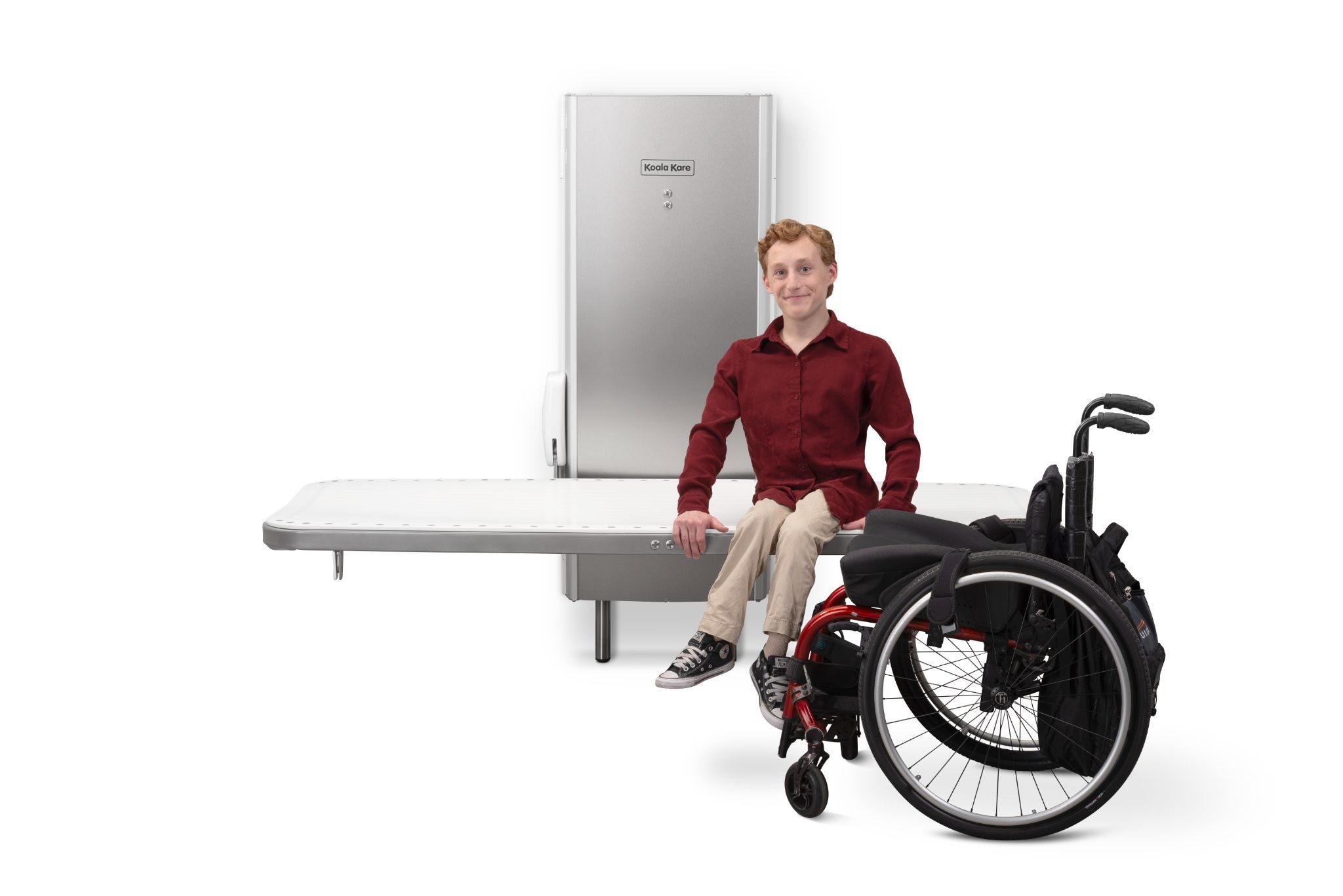
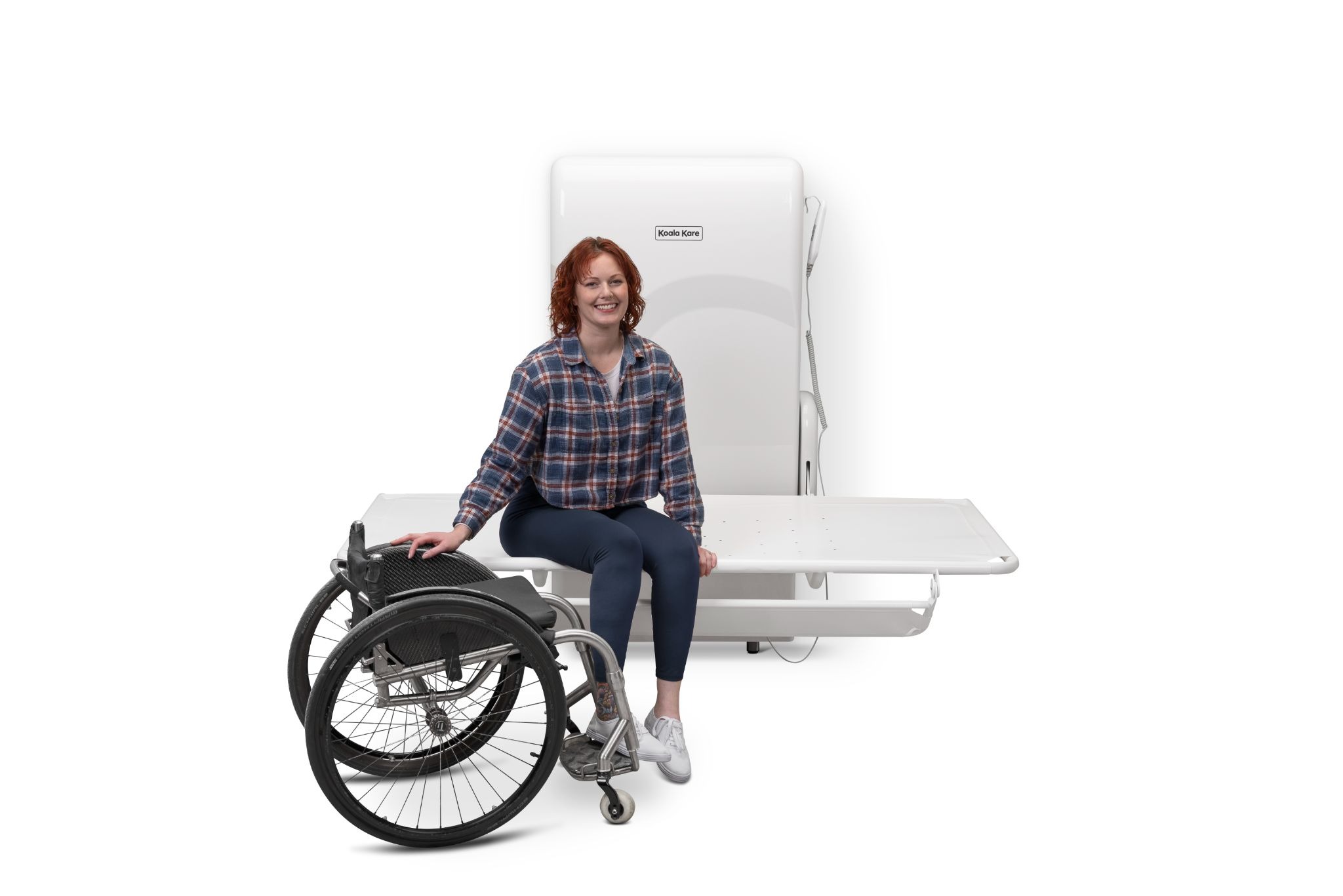
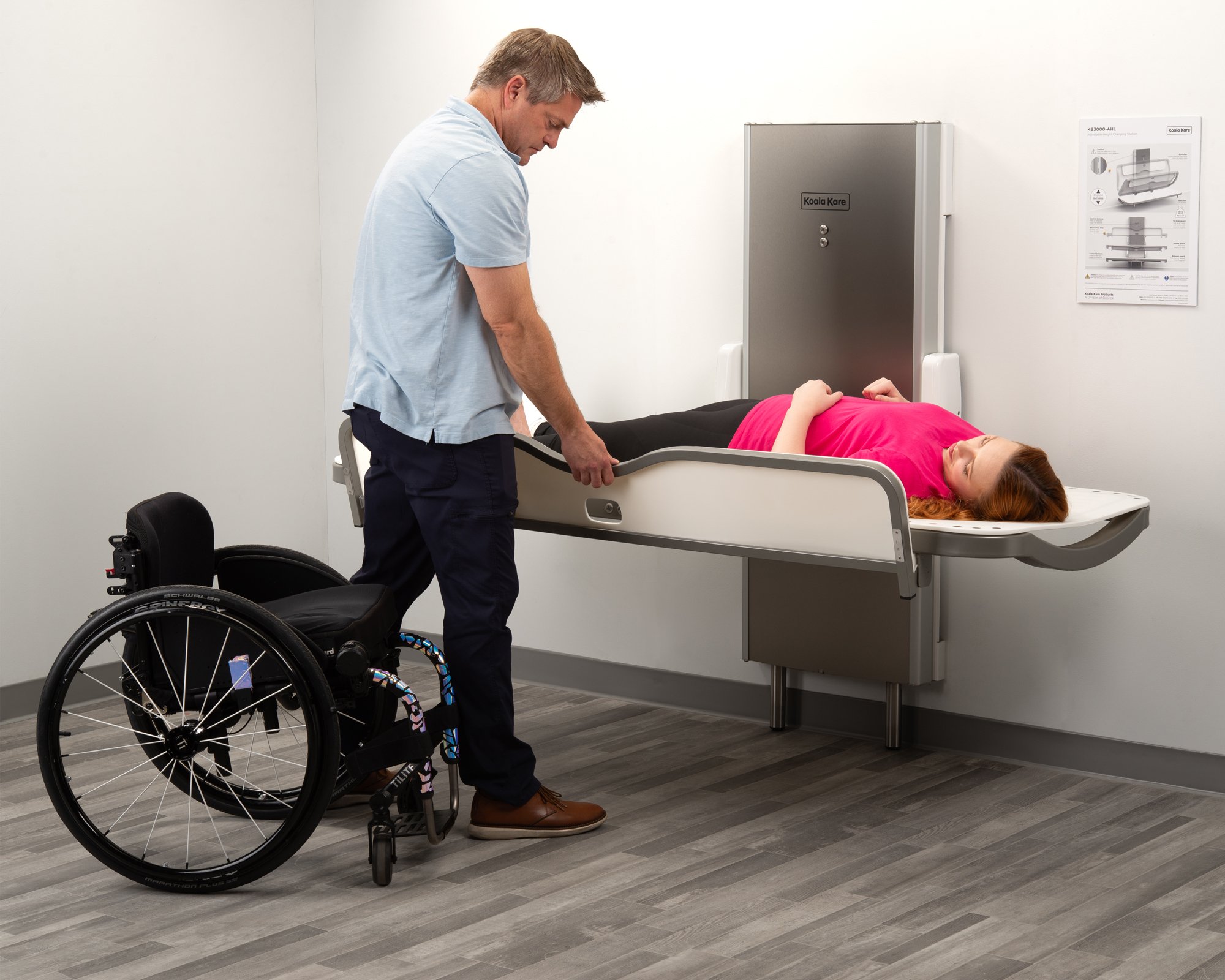
An adult changing station is a wall-mounted, height-adjustable platform designed to support individuals who need assistance for restroom use or changing and are too large for a baby changing station. These are devices engineered with high weight capacities and powered lift systems to facilitate safe transfers from wheelchairs.
Integrating an adjustable-height adult changing station into a facility requires more than floor space; it requires a private area and specific structural, electrical, and durability considerations.
Choosing the Model by Environment
What’s the difference between Koala Kare Products’ KB3000 and KB2600 Adult Changing Stations? To select the optimal model for your project, consider the environment where it will be used, the level of use, and public access points.
High-Traffic Environments: KB3000
Best for: Airports, stadiums, and transit hubs
Vandalism-resistant engineering: Holds an IK10 rating (the highest impact resistance) and features a cut-resistant polyethylene changing surface.
Integrated control system: Has height controls built directly into the wall panel and the front of the bed so there are no exposed cables or remotes, mitigating risk in unsupervised areas.
Enhanced accessibility: Lowers to 12 inches from the floor (300mm) for easier wheelchair transfers and features a curved dip in the safety guard for ergonomic caregiver access.
Controlled and Clinical Environments
Best for: Hospitals, retail, and care facilities
Aesthetic integration: Has a clean, contemporary design that fits modern commercial interiors.
Handheld operation: Uses a wired remote (IK9 rated) that provides caregivers with flexibility during the changing process in a supervised setting.
Surface: Uses a high-tension, non-rip vinyl stretcher for patient comfort and easy sanitation.
Technical Specification Comparison
Specification
KB3000
KB2600
Best for
Airports or schools
Hospitals or retail centers
Safe Working Load
500 lbs. (227 kg.)
440 lbs. (200 kg.)
Stretcher Surface
Cut-resistant and antistatic polyethylene
High-tension vinyl
Impact Range
IK10
IK9
Height Range
12″ – 41″ (300mm – 1,040mm)
13.7″ – 37.4″ (350mm – 950mm)
Electrical Safety
ISO 60601-1 / ISO 60601-2
UL 962 / CSA C22.2
Critical Installation and Rough-In Requirements
Unlike baby changing stations, adult changing stations are heavy-duty electrical machinery. Successful integration starts at the framing stage.
Structural Reinforcement
The static and dynamic load of these units is significant.
Wall construction: Must be flat and able to bear a load of 1,250 lbs. (566 kg.)
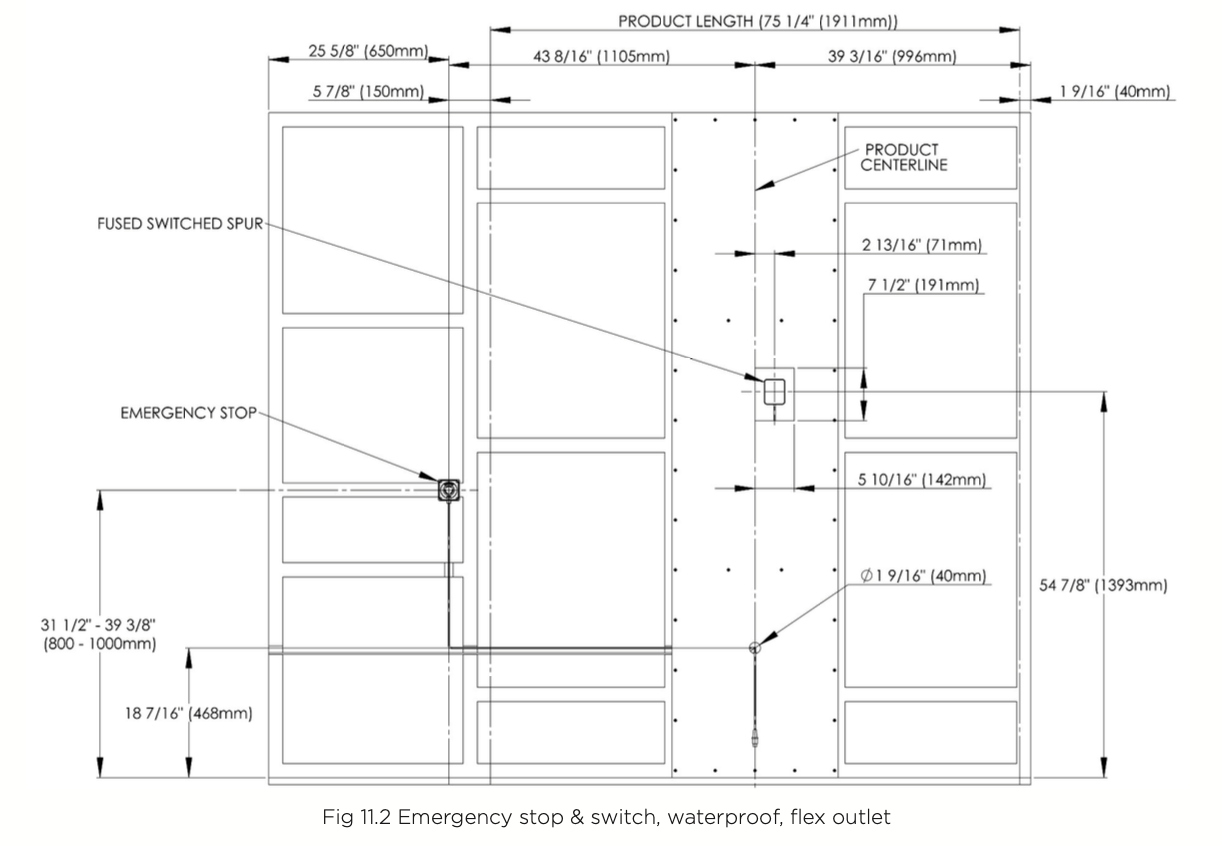
Marine plywood backing: Koala Kare Products requires 1-inch-thick (25mm) marine plywood facing that extends from floor to ceiling, secured every 7 7/8 inches.
Blocking conflict: Ensure horizontal cross members do not align with the station’s mounting points to avoid drilling into structural hardware during final fit-out.
A diagram from the KB3000 installation guide that shows the fittings for the emergency stop and the switched, waterproof flex outlet.
Electrical and Space Planning
Power supply: Requires a Class II power supply via an isolatable flex outlet on a GFCI protected circuit.
Spatial footprint: Needs at least a 108 5/16-inch (2751mm) area to ensure adequate clearance at both ends of the unit for caregiver movement.
Concealed wiring: The KB3000 requires the electrical rough-in to be positioned precisely behind the unit to conceal all wiring in order to maintain its vandalism-resistant status.
Koala Kare Products have created comprehensive installation and user guides for the KB3000 and the KB2600 that detail the technical specification, overall dimensions, and more.
Compliance and Safety
From a facility management perspective, liability and uptime are paramount. Both models are engineered with critical safety features.
Battery backup system: Every unit includes a built-in battery to ensure that in the event of a building power failure, the table can still be lowered.
Emergency stop: The KB3000 features a dedicated emergency stop button, giving caregivers immediate control to halt movement if an obstruction is detected.
Water resistance: Both units are IPX4 rated, making them suitable for wet environments and allowing for standard restroom cleaning protocols without damaging the electrical components.
Final Steps Before Purchasing an Adult Changing Station
Navigating the purchasing process for specialized equipment requires local expertise. To move from the design phase to procurement, architects and facility managers can use the following resources:
Know before you buy: Before finalizing your purchase, use Koala Kare Products’ legislation map to determine whether your specific jurisdiction has mandated adult changing stations, ensuring your facility is compliant with state or local codes.
Product selection guide: Review the specifications, resources, installation guides, and more for Koala Kare Products’ KB3000 or KB2600 Adult Changing Station to see which unit aligns with your specific traffic and maintenance needs.
Do you have additional questions? Reach out to our team for help choosing a model or for assistance with wall reinforcement and electrical layouts.
Whether you’re already specifying adult changing stations or just hearing the term for the first time, a new standard of accessibility is here. Our continuing education course ensures you have the technical expertise to get it right — the first time.
The Dignity in Design CE course through Architectural Record defines these units and explains how adult changing stations enhance inclusivity and accessibility for people with physical or mobility disabilities in public buildings.
Successfully pass the online course, and you will earn the following credits:
Architects: 1.0 AIA LU/HSW
Designers: 1.0 IDCEC CEU/HSW
Code Officials: 0.1 ICC CEU
A caregiver assists an adult on a Koala Kare KB3000-AHL height-adjustable adult changing station. Learn about these stations and how to specify them with the Dignity in Design CE course.
What is an adult changing station?
An adult changing station is a height-adjustable table designed for individuals who cannot use a standard or ADA-compliant restroom for their personal care needs. While often found in a single-user or family-assisted public restroom, the table itself is the critical component that:
Supports all ages from 2 through adulthood
Provides a heavy-duty capacity, typically rated to at least 440 lbs
By adding these units to a dedicated universal or family-assisted restroom, those who use them maintain their privacy and dignity while changing clothes, managing catheters, or replacing incontinence pads.
Even if you feel you know the ADA requirements for bathrooms backward and forward, this new CE course is designed to ensure you’ll be ready to specify the main components of an adult-size changing station and understand the inclusive features of an individual restroom equipped with such a station.
Once you are ready to specify a station, Koala Kare Products offers two units:
KB2600 Adult Changing Station, a contemporary model often specified for controlled environments such as small schools, medical offices and houses of worship.
What are the design considerations when adding an adult changing station?
These spaces typically require a larger footprint than a standard ADA restroom to account for the table’s bed in the down position, plus the required clear floor space for a wheelchair. Also, height-adjustable units require structural blocking in the wall to support the user and a dedicated electrical circuit, usually 120V.
While the Dignity in Design course dives deep into the specific dimensions, there are three critical areas you should consider:
Structural support: Does your wall assembly have the reinforced blocking required for a rated capacity of 440 lbs.?
Power requirements: Have you coordinated with your electrical engineer for the dedicated circuit needed for height-adjustable units?
Clearance envelopes: Have you accounted for the fold-down footprint and the wheelchair maneuverability space?
The full course covers how to analyze design considerations for these dedicated restrooms, including space, layout, structural, and other compliance criteria.
Are adult changing stations required?
From legislative mandates to changing code requirements, architects and designers should be aware of this solution that brings accessibility to people with disabilities, specifically those who are nonambulatory or have self-care challenges. Although the Americans with Disabilities Act does not yet require adult changing stations, building codes and other legislation now address this need.
The International Building Code includes a requirement that adult changing stations be provided in assembly and mercantile spaces with family or assisted-use toilets, college facilities, assembly spaces, and highway rest stops/service plazas, and that these stations meet defined accessibility and location criteria. Review the ICC A117.1 (Accessible and Usable Buildings and Facilities) to see the technical standards for how adult changing stations are built and check the code in your locale before starting a new project.
The Federal Aviation Administration Reauthorization Act of 2024 requires enhanced accessibility accommodations at medium and large U.S. airports, including provisions that drive the installation of adult changing stations in passenger terminal facilities by 2030.
Nine states have enacted legislation requiring these stations, and multiple other states have pending or proposed legislation. Whether you are designing for projects in California, Illinois, or Ohio staying ahead of state-specific adult changing station mandates is critical. See more details with our legislative map.
Who benefits from adding an adult changing station?
When the scope of disabilities is fully understood, the need for dedicated, inclusive restroom accommodation becomes profound. These dedicated, private restroom facilities are ideal for anyone with:
Mobility disabilities
Cerebral palsy
Multiple sclerosis
Muscular dystrophy
Spina bifida
Severe anxiety
Autism
Advanced dementia
Inflammatory bowel diseases
Crohn’s disease
Epilepsy or conditions causing seizures
Without these stations, caregivers are often forced to change adults on restroom floors — an immense hygiene and safety risk for both the user and the caregiver. Alleviating that concern for caregivers is part of the reason this course credit is Health, Safety, and Welfare–approved.
Plus, the impact is material: 1 out of 4 Americans with mobility disabilities will leave a business and never return if they encounter an accessibility barrier.
Once you’ve completed the course, reach out to a Koala Kare Products representative for answers to any questions you may have about the product, specification, maintenance, installation, and more. Or visit koalabear.com.
Note: This post continues our series on improving public accessibility by installing universal changing stations in key gathering spaces. See Part 1 here.
Medical offices buildings, physical therapy clinics, rehabilitation centers, and other such facilities exist to provide healing, comfort, and support. But what happens when these places fail to meet a basic human need?
Many outpatient facilities still lack adult changing stations, leaving patients and caregivers without a clean, safe, and appropriate space to manage personal care. This disconnect between the clinic’s mission and its infrastructure creates unnecessary hardship on the cared-for and caregiver.
While exam rooms at many doctor’s offices are designed for accessibility, public washrooms in medical plazas and PT clinics may not have a dedicated space to provide dignified incontinence care to those who cannot use a standard restroom. Caregivers are forced to improvise in undignified, unsafe ways — compromising both hygiene and respect.
Physical and occupational therapy centers: Where patients may experience fatigue or reduced mobility following intensive treatment.
Geriatric care clinics: For older patients with limited mobility or incontinence.
Neurology and stroke centers: Where patients may have complex transfer needs that cannot be accommodated in a standard bathroom stall.
Pediatric specialty offices: For older children with disabilities who have outgrown standard baby changing tables.
Safety in Every Setting
As legislative momentum to require adult changing stations in public places grows, doctors and clinic owners can get started now to offer comfort, safety, and respect to everyone who comes to their office.
By providing a secure, hygienic, and private space for changing, you will:
Protect patient dignity and caregiver well-being
Prevent injury to patients and caregivers through appropriate lift-assisted support
Reinforce your commitment to comprehensive care
When facility managers prioritize these accommodations, that commitment to excellence will be reflected in patient satisfaction ratings and the practice’s overall reputation.
Bringing an Adult Changing Station to Your Practice
The ease of use and safety of the Koala Kare KB2600 Adult Changing Station is ideal for many public buildings. The features include:
Weight capacity: Supports up to 440 lbs. (200 kg.), accommodating a wide range of patient profiles.
Powered height adjustment: With the handheld device, the table lowers to 12 inches and raises to 37 inches, allowing for smooth, level transfers from a wheelchair to the changing surface.
Hygienic design: Nonporous, high-tension vinyl is resistant to fluids and easy to disinfect between uses.
Fail-safe features: Integrated battery backup ensures the unit remains functional even during power interruptions.
Foldable design: The unit folds against the wall when not in use, preserving the 60-inch turning radius required for ADA-compliant restrooms.
Providing an inclusive environment is a cornerstone of modern healthcare. Stay ahead of any legislation mandates and enhance your practice’s accessibility today. Contact a representative to learn more about installing adult changing stations at your office.
Note: This post continues our series on improving public accessibility by installing universal changing stations in key gathering spaces. See Part 1 here.
Airports are gateways to the world, but for many travelers with mobility challenges, those gateways can also feel like barriers.
While most airports have made strides toward accessibility with ramps, elevators, and family restrooms, most terminals are still missing one essential feature: dedicated restrooms with adult changing stations.
These products, also referred to in federal legislation as a universal changing station, are a specialized space designed to provide a safe, sanitary, and dignified area for individuals with disabilities who cannot use a standard toilet. While the law is changing, the current gap in infrastructure leaves travelers and caregivers in a difficult position.
The Accessibility Gap in Air Travel
Travelers may need to manage long security lines, delayed flights, and limited restroom availability. Additionally, for adults and children with disabilities who require assistance with personal care, standard restrooms simply aren’t enough. Caregivers are left with the options of using the restroom floor or makeshift surfaces that are unsanitary, unsafe, and deeply undignified.
Without adult changing stations, these travelers may choose to avoid flying altogether, cutting off access to opportunities, experiences, and independence. By including a dedicated space with powered, height-adjustable adult changing tables, these facilities provide:
Safe and hygienic travel for adults with disabilities and their caregivers
Dignity and privacy during an essential daily routine
Peace of mind that encourages more travelers with disabilities to fly
Why Airports Must Adapt: The FAA Reauthorization Act of 2024
Millions of adults live with a disability and many travel for work, family, or medical reasons. As airports compete to improve the passenger experience, adult changing stations are a powerful investment in accessibility and humanity that’s soon to be required.
The act isn’t just a suggestion — it’s a requirement for these airports to maintain their federal funding eligibility.
Timeline for compliance: Guidance on comprehensive accessible design standards is expected by 2026. Airports have until fiscal year 2030 to meet the new requirement.
Planning for the future: While the deadline seems distant, the planning, design, and procurement phase starts now.
There are thousands of airports in the U.S., and 500 of those are public-use and eligible for federal funding, according to the U.S. National Plan of Integrated Airport Systems. A little more than 30 U.S. airports, including Orlando (MCO), Chicago (ORD), Minneapolis (MSP), Phoenix (PHX), and Seattle (SEA), have already installed adult or universal changing stations, receiving widespread praise from advocacy groups and travelers alike.
While the FAA Reauthorization Act focuses on large hubs, smaller airports stand to gain a competitive edge by acting early. Accessible tourism is a rapidly growing market. By installing universal stations now, airports can market themselves as barrier-free hubs, attracting loyal travelers who prioritize dignity and safety.
Plus, when an airport is seen as accessible-friendly, these travelers, caregivers, and families are more likely to choose that hub, spending money at terminal concessions and duty-free shops. That turns adding a height-adjustable adult changing station into an investment for future revenue, not just a cost.
Is your terminal ready for 2030?
For those medium and large airports without an adult changing station, now is the time to get started. Moreover, it’s more cost-effective to integrate these stations during scheduled terminal refreshes than to perform a rushed, standalone retrofit as the 2030 deadline looms.
To meet these upcoming mandates, Koala Kare’s KB3000-AHL Adult Changing Station is designed for the needs of high-traffic environments like airports. Features include:
500 lbs. weight capacity
A height-adjustable changing surface controlled by buttons on the bed or the face of the wall cover.
Integrated recessed height controls designed to withstand tampering
2” powder-coated, rust-free steel tubing
An IPX4 rating, which means the unit can withstand significant exposure to water without damage to its electrical components
A backup battery to guarantee operation even during a power outage.
Smooth polyethylene changing surface, that is vandal-resistant and can be easily wiped down and cleaned
For airport facility managers, the IPX4 rating is critical because it allows janitorial teams to perform deep-sanitation routines without worrying about damaging the adult changing station. Similarly, the recessed height controls are vital in a 24/7 public environment where equipment is subject to high-frequency use and potential tampering.
We and our third-party advertising and analytics partners use cookies and other tracking technologies on this website to enhance user experience, analyze performance and web traffic, and for targeted advertising purposes. If you consent to the use of non-essential cookies, you also consent to us sharing information about your device, preferences, and interaction with the website with our third-party partners. Please note that if you decline certain types of cookies, some website features may not work properly.
Functional
Always active
The technical storage or access is strictly necessary for the legitimate purpose of enabling the use of a specific service explicitly requested by the subscriber or user, or for the sole purpose of carrying out the transmission of a communication over an electronic communications network.
Preferences
The technical storage or access is necessary for the legitimate purpose of storing preferences that are not requested by the subscriber or user.
Statistics
The technical storage or access that is used exclusively for statistical purposes.The technical storage or access that is used exclusively for anonymous statistical purposes. Without a subpoena, voluntary compliance on the part of your Internet Service Provider, or additional records from a third party, information stored or retrieved for this purpose alone cannot usually be used to identify you.
Marketing
The technical storage or access is required to create user profiles to send advertising, or to track the user on a website or across several websites for similar marketing purposes.
We and our third-party advertising and analytics partners use cookies and other tracking technologies on this website to enhance user experience, analyze performance and web traffic, and for targeted advertising purposes. If you consent to the use of non-essential cookies, you also consent to us sharing information about your device, preferences, and interaction with the website with our third-party partners. Please note that if you decline certain types of cookies, some website features may not work properly.
Functional
Always active
The technical storage or access is strictly necessary for the legitimate purpose of enabling the use of a specific service explicitly requested by the subscriber or user, or for the sole purpose of carrying out the transmission of a communication over an electronic communications network.
Preferences
The technical storage or access is necessary for the legitimate purpose of storing preferences that are not requested by the subscriber or user.
Statistics
The technical storage or access that is used exclusively for statistical purposes.The technical storage or access that is used exclusively for anonymous statistical purposes. Without a subpoena, voluntary compliance on the part of your Internet Service Provider, or additional records from a third party, information stored or retrieved for this purpose alone cannot usually be used to identify you.
Marketing
The technical storage or access is required to create user profiles to send advertising, or to track the user on a website or across several websites for similar marketing purposes.