




Are Your Washrooms and Changing Stations ADA & ICC A117.1 Compliant? Accessibility Standards Businesses Need to Know.
Meeting the accessibility standards in your commercial washroom is not only good business practice, in the case of the ADA, it is also federal law.
However, ensuring your design truly complies with the rules set by the Americans with Disabilities Act and the International Code Council A117.1 Standards can be tricky. While architects are professionally bound to design buildings that meet these standards, the legal liability for compliance ultimately falls on the building owner. Even if a design failure is considered a breach of an architect’s standard of care, the owner remains legally vulnerable.
Beyond protection, compliance is about people. Roughly 1 in 4 U.S. adults lives with a disability, and millions more are caregivers making destination decisions on their behalf. To ignore their needs is to ignore a massive segment of the market.
While ADA and ICC A117.1 standards are the threshold you must clear, going above and beyond can turn accessibility into a genuine competitive advantage.
Let’s look at the accessibility standards and how to ensure you’ve achieved the minimum requirements, and how baby and adult-size changing stations allow you to serve the customers others are missing.
ADA is Civil Rights Law to Fight Discrimination
The Americans with Disabilities Act, enacted in 1990, is a landmark federal civil rights law. It prohibits discrimination against individuals with disabilities in all areas of public life, including the places we shop, eat, and work. For business owners, the instruction manual for following this law is the 2010 ADA Standards for Accessible Design.
These ADA standards act as the governing framework for two main groups:
- Title II: Covers state and local government facilities.
- Title III: Covers public accommodations, which includes virtually every private business that serves the public such as retail, restaurants, hotels, and theaters.
2017 ICC A1117.1 Accessibility Standards for New vs. Existing Buildings
The ICC standard establishes requirements based on:
- New construction: Must fully comply with larger clear floor space for wheelchairs 30” wide, 52” in length minimum, and 67” minimum diameter wheelchair turning space.
- Existing facilities: Allowed to use smaller 30” x 48” minimum clear floor space and 60” diameter wheelchair turning space.
Achieving the Minimum ADA & ICC A117.1 Washroom Accessibility Requirements
Meeting ADA and ICC A117.1 accessibility standards is a game of inches. While architects handle the blueprints, these are the five areas where most compliance errors occur during construction or daily operations.
For the fixtures themselves, the ADA and ICC A117.1 is incredibly specific. Here are the primary measurements required:
| Feature | ADA & ICC A117.1 Requirements | Why It Matters |
Toilet Seat Height | 17 to 19 inches | Matches standard wheelchair height for safer lateral transfers. |
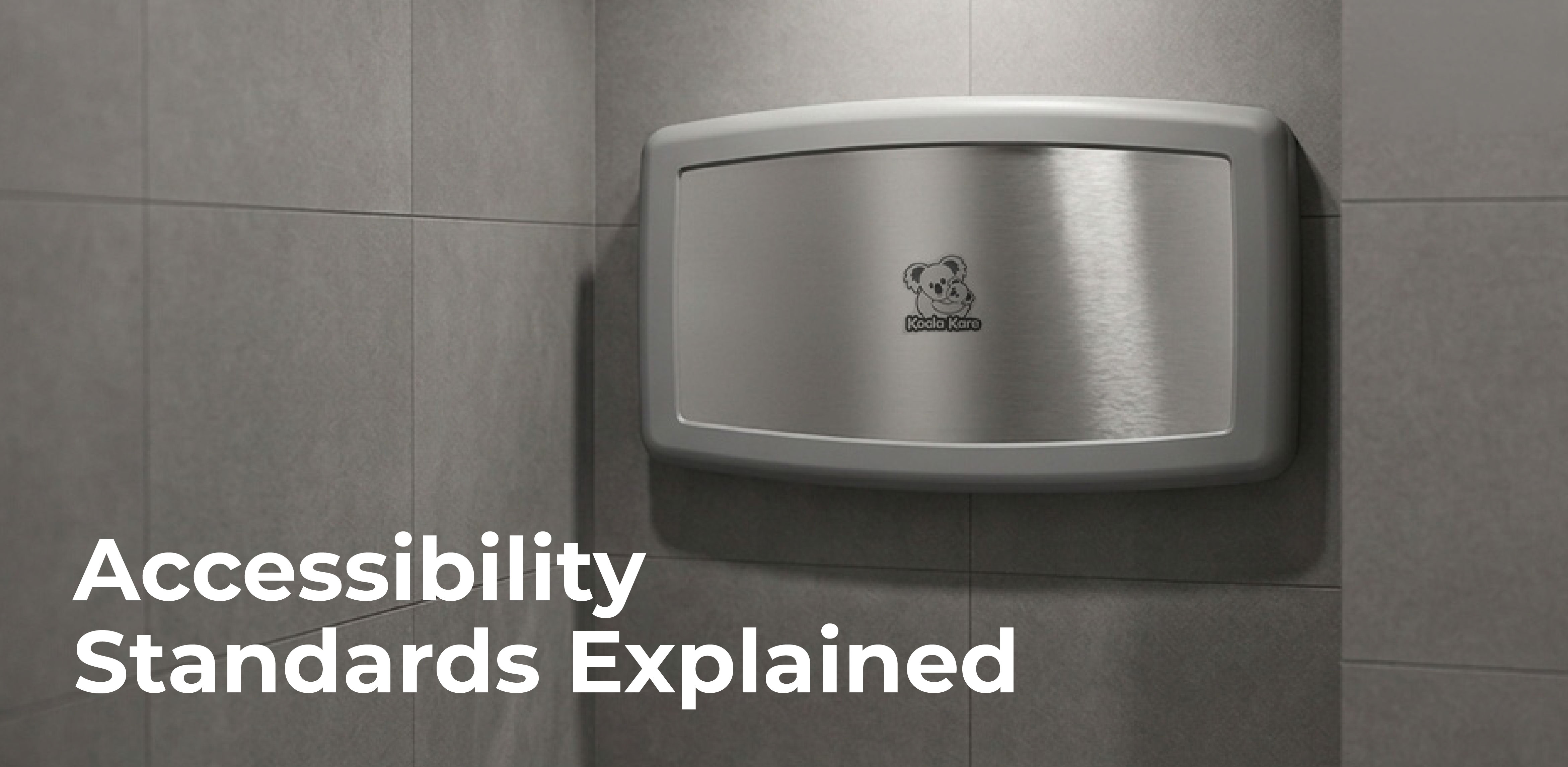
| Protrusion Limit | Max 4 inches from wall | Ensures wall-mounted objects (such as closed changing tables) don’t become hazards for the visually impaired. Koala Kare’s KB300 model is the first surface-mounted baby changing station to meet this requirement without needing to be recessed into the wall. |
| Toilet Placement | 16 to 18 inches from side wall | Ensures the user can reach the grab bar and maneuver parallel to the seat. |
| Lavatory, Countertop Height | 34 inches max | Prevents the lavatory, countertop from being too high for a seated user to reach. |
| Knee Clearance | 27 to 29 inches high | Allows a wheelchair to roll directly under the lavatory, countertop for handwashing. |
| Grab Bar Height | 33 to 36 inches from floor to the top of the grab bar | Provides the optimal leverage point to prevent falls during transfer. |
1. Clearances and Maneuvering Room
A washroom can have all the right equipment, but if a wheelchair user can’t turn around, it’s effectively closed to them.
- The ADA’s 60-inch circle and ICC’s 67-inch circle: You must maintain a clear floor space of at least 60 inches or 67 inches in diameter to allow a wheelchair to make a 180- or 360-degree turn.
- This radius must be maintained even when a baby changing station is in the down or open position.
- The 42-inch rule: The safe, accessible circulation route leading to and within the washroom must be 42 inches wide at a minimum at all points.
Pro tip: When installing a baby changing station, ensure the handle (the highest operable part) is no higher than 48 inches from the floor so a person in a wheelchair can reach and open the unit independently. Koala Kare Products’ KB311 and KB310 models are specifically designed to meet this requirement, and the KB310 also meets the 2012 Texas Accessibility Standard (TAS).
2. Doors and Hardware
Compliance starts at the door.
- The closed fist test: All hardware (handles, locks, flush valves, and faucets) must be operable with one hand without tight grasping, pinching, or twisting the wrist. If you can’t operate it with a closed fist, it’s likely a violation.
- Opening force: Interior doors should require no more than 5 lbs. of force to open.
3. Grab Bars: More Than Just a Rail
Grab bars are the most critical safety feature in the room. To be compliant, they must:
- Be heavy-duty: Withstand at least 250 lbs. of force.
- Be long enough: The rear wall grab bar must be at least 36 inches long, while the side wall grab bar must be at least 42 inches long.
- Stay clear: Maintain absolute 1 1/2 inches of space between the grab bar and the wall so a hand can firmly clasp the grab bar and an arm cannot become trapped and injured between the grab bar and the wall.
4. Signage and Wayfinding
To serve people with visual impairments, signs must be more than just high-contrast.
- Tactile elements: Signs must include Grade 2 Braille and raised pictorial symbols (pictograms).
- Mounting height: Signs should generally be mounted so the baseline of the lowest tactile character is 48 inches minimum and 60 inches maximum above the floor.
Baby and Adult-Size Changing Stations: The Missing Piece to Any Washroom
Changing stations offer enhanced accessibility that exceeds federal minimums, ensuring your facility is prepared for evolving building standards and higher guest expectations. Providing safe, clean, and dedicated spaces has become a societal expectation. In a 2025 survey, 75% of respondents said they’d think twice before returning to an establishment after a bad washroom experience.
For parents with young children, the absence of a baby changing station is enough to make them choose a different destination next time.
For customers with disabilities and their families or caregivers, a missing adult-size changing station means they can’t use your facility at all — no matter if the rest of the building is 100% ADA and ICC A117.1 compliant.
Baby Changing Stations: What is Required
When installed in a commercial washroom, a baby changing station is classified as a work surface. To remain compliant with the 2010 ADA Standards and the ICC A117.1 Standards, your installation must meet these six specific criteria:
- Mounting height (handle): The highest operable part (the handle) must be no higher than 48 inches from the floor. This ensures a person in a wheelchair can reach and open the unit independently.
- Open surface height: When the station is folded down, the changing surface must be between 28 and 34 inches above the finished floor.
- One-hand operation: The unit must be operable with a single hand. It cannot require tight grasping, pinching, or twisting of the wrist, and must require less than 5 lbs. of force to open.
- Clear floor space: You must maintain a clear floor space of 30 inches wide by 48 inches deep minimum directly in front of the station for a forward wheelchair approach for existing buildings; and 30 inches wide by 52 inches deep for new buildings, per the ICC A117.1.
- Knee and toe clearance: To allow a wheelchair to tuck under the station safely, you need a minimum of 27 inches of knee clearance and 17 inches of toe clearance (19 inches in California).
- The 60-inch ADA and 67-inch ICC A117.1 turning circle: Even when the station is in the open position, it cannot obstruct the 60- or 67-inch diameter maneuvering space required for a wheelchair to turn around.
- State-specific warning: In California, baby changing stations are prohibited inside the accessible toilet compartment itself to ensure the path to the toilet remains completely unobstructed for wheelchair users.
Our range of safe, innovative, durable baby changing stations offer solutions to meet the needs of your business and the families who visit. Learn more about Koala Kare baby changing stations.
The BABIES Act and State Legislation: A Rapidly Expanding Patchwork
Congress passed the Bathroom Accessible in Every Situation (BABIES) Act a decade ago to require baby changing accommodations in both male and female washrooms in all publicly accessible federal buildings.
In addition, states have also enacted similar mandates. California (AB-1127) and Illinois (HB-3711) require baby changing stations in public washrooms, and Arizona (HB-2113) requires baby- and adult-capable stations when building or renovating a washroom. Then, some cities also require baby changing stations, such as Spokane, Washington, and New York City.
It’s a lot to keep track of, especially because compliance requirements vary significantly by state and change every legislative session. Check out Koala Kare’s legislation map to see what’s required in your area.

Adult-Size Changing Stations: A Missed Opportunity for Many Businesses
Adults with disabilities who need assistance changing have almost no options in most public facilities. The need extends beyond obvious disability categories such as multiple sclerosis, cerebral palsy, spinal cord injuries, aging-related conditions, post-surgical patients, and individuals with temporary mobility impairments.
For these individuals, when there isn’t a safe, clean space to use the washroom, caregivers are faced with making do on bathroom floors, leaving events early, or not even participating at all.
Throughout the United States, Canada, and across the world, governmental and nongovernmental bodies have introduced or are considering requirements and recommendations related to the installation of adjustable, adult-size changing stations in public facilities. See details of what’s required in your area with our legislation map.
Because the ADA was written before adult changing stations were common, rather than their own specific category, adult-sized stations currently fall under work surface standards regarding work surface height, clear floor space, knee and toe clearances, and one-hand operable hardware.
In 2024, Section 613 of the ICC A117.1 with Supplement 1, became the accessibility standard for adjustable height changing stations for adults.
If your facility installs a changing station for adults, you’re signaling to nearly 1 in 4 Americans with a disability and their caregivers that your building offers a level of care that virtually no competitors offer. Learn more about Koala Kare adult changing station models.
By Not Meeting Diverse Populations’ Needs, You’re Turning Away a Multitrillion-Dollar Market
People with disabilities represent $1.9 trillion in annual disposable income in the U.S. alone. The American Institutes for Research says the market more than doubles in effective size when accounting for companions, family members, and friends who make purchasing decisions based on inclusive access.
Customers within the disability community are loyal to brands that accommodate their needs. If a restaurant is the only one in town with a truly accessible washroom or an adjustable-height adult-size changing station, the restaurant becomes the permanent choice for that entire social group. Plus, 54% of non-disabled consumers say they are more likely to favor companies that demonstrate authentic inclusion.
The “Bare Minimum” Checklist Approach Creates Hidden Gaps
Knowing the requirement is only half the battle. Simply marking off dimensions on paper does not guarantee real-world usability. A technically compliant changing station installed inside a wheelchair accessible toilet compartment blocks the toilet availability.
Be sure to pick the right accessories for your washrooms as well. ADA compliance expert Joan Stein warns that products are often marketed as ADA-compliant when the full installation context does not pass muster. That’s why we created this accessibility compliance guide for the Koala Kare KB300 series. It clearly illustrates the proper dimensions, work surface height, forward reach, and more to ensure compliant installation.
And don’t forget what not having a baby changing station says about your business. Failing to equip men’s rooms with changing stations signals to fathers, male caregivers, and nonbinary caregivers that they are not welcome.
Not offering an adjustable-height, adult-size changing option communicates that adults with significant disabilities are not part of your customer base.
We’re Here to Help
ADA and ICC A117.1 accessibility standards exist because every customer deserves to use your facility with dignity and independence. Businesses that understand this do not just check boxes, they install washrooms that actually work for everyone.
Explore Koala Kare baby changing stations and adult changing stations to find the right solution for your facility. Helping you equip your operations to accommodate the needs of caregivers and their children is what we’re all about. Contact a Koala Kare Products representative today if you have questions about products, pricing, installation, replacement parts, and more.
