




Go Beyond the High Chair to Provide Restaurant Seating for All of Childhood’s Stages
On a Friday night at a busy restaurant during dinner rush, a family with a baby in a car seat and a toddler walks in to eat. But there aren’t enough high chairs available, and the table is too tall for the toddler. The family rethinks coming back to this establishment due to this inconvenience.
Restaurants not offering the correct mix of child seating options can be a common scenario. Most mainstream restaurants understand the value of family dining and offer some child seating. However, a common oversight is treating child seating as a one-size-fits-all requirement. A toddler has vastly different needs than a newborn in an infant car carrier.
Providing a welcoming environment for families means catering to every stage of childhood development. Offering incompatible seating or expecting parents to improvise creates safety hazards, slows down service, and harms your business’s reputation.
Here are the three critical stages of child seating, the operational factors to consider for each, and how to select the right seating solutions for your dining room.

Stage 1: Infant Seating Solutions
The infant stage is one of the most frequently overlooked phases in commercial restaurant design. Parents arriving with newborns almost always carry them in heavy, bulky infant car seat carriers.
Unaware that it is a safety hazard, parents may want to flip traditional restaurant high chairs upside down and then balance the infant carrier between the legs. However, high chairs are not designed to support the weight or shape of an infant carrier in an inverted position. Doing so creates an unstable, top-heavy arrangement that can easily be knocked over by a passing server, a sudden bump, or the movement of the baby.
What to Look for in Infant Seating
Low maintenance materials: Look for removable, machine-washable, or easy-to-sanitize fabrics and materials that handle accidental spills with ease.
Infant-specific engineering: Choose seating specifically engineered to hold infant carriers securely off the floor.
Compact, foldable footprint: Select cradles that fold flat when not in use for easy storage so they don’t obstruct high-traffic server aisles.

Stage 2: Restaurant High Chairs for Toddlers
Once children can sit upright independently (around 6 months to 3 years old), they move into Stage 2 seating, which is in high chairs. Restaurant high chairs are heavily used, so durability and hygiene are critical.
What to Look for in Commercial High Chairs
- Anti-inversion design: Modern high chairs should be intentionally designed with curved frames or specific geometry so they cannot be turned upside down, eliminating the possibility of improper use and liability.
- Easy-to-clean surface: Wood high chairs often warp, splinter, or absorb liquids over time, with crevices that trap food particles. Modern plastic models that feature seamless, nonporous surfaces can be easily wiped down instantly between table turns.
- Safety compliance: Ensure the high chair meets current ASTM standards and features secure three-point restraint systems to prevent slips and falls.
- Table-height ergonomics: Opt for table-height seating that allows children to eat directly off the restaurant table alongside their family, eliminating the need for bulky, hard-to-clean trays.

Stage 3: Commercial Booster Seats for Young Children
The third stage serves children who have outgrown restaurant high chairs but are still too short to reach the table comfortably from standard dining chairs or booths (typically ages 3 to 5).
Without a proper booster, children end up kneeling on chairs or slouching, leading to uncomfortable meals and fidgety behavior that affects nearby guests.
What to Look for in Restaurant Booster Seats
- Secure attachment: High-quality boosters feature integrated security straps to anchor the booster firmly to the adult chair, preventing shifts or slides while the child moves.
- Surface protection: Boosters should feature nonskid, nonscratching feet that grip both hardwood and upholstered chairs without damaging the restaurant’s furniture.

Elevate Your Family Dining Experience with Koala Kare
Providing a family-friendly environment requires having the right seating options for every age. In addition to safety and functionality, consider the visual harmony of your floor space. Mixing mismatched wooden high chairs, plastic boosters, and metal frames can make your dining room feel cluttered. Selecting seating lines designed to complement one another across all three stages creates a polished, professional look that aligns with your business’s interior design.
At Koala Kare Products, we offer a comprehensive lineup of commercial-grade child seating built for every developmental stage and aesthetic:
- Provide the KB115 Infant Seat Kradle to offer a safe, compact folding solution for car carriers, eliminating hazardous improvisations.
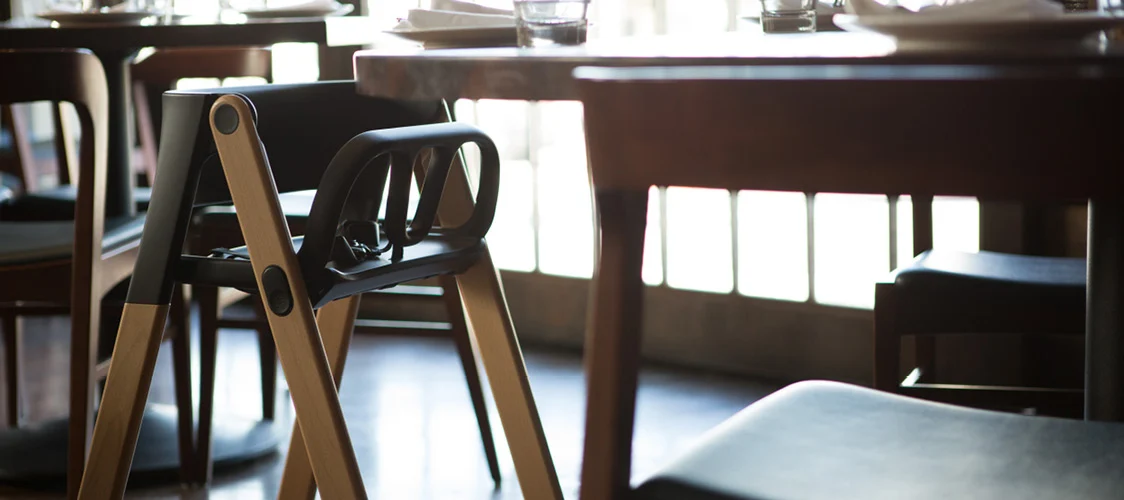
- Choose between the KB615 Koala Stowe™ flat-folding contemporary wood/plastic chair, our durable KB105 Designer High Chair, or the stackable KB950 Diner High Chair. (Not sure which is right for your business? Check out our blog on finding the right high chair.)
- Complete your seating with the reversible KB854 Diner Booster with two height options or the KB328 Designer Booster Seat, featuring Microban product protection and surface-friendly grip feet.
By coordinating your seating choices across all three stages, you ensure safety compliance, streamline table turns for your staff, and present a cohesive, professional look throughout your dining space.
Explore all of Koala Kare’s seating options to find what works best for your business.
